Showing posts with label lists. Show all posts

Monday, July 21, 2025

13 games every game designer must play

13 GAMES EVERY GAME DESIGNER MUST PLAY*

The internet is filled with lists about the best games that every game designers MUST play, however I find them to often be a bit arbitrary and directionless. 

Why do game designers NEED to play these games? What are they learning from each of these games? I was interested in creating a list of games that better represent the game genres that some others lists I've read about.

Dominion : Even though it's the first ever game of the deck building genre, it's still holds up. It's simplicity makes it the clearest example of the genre. While there are other good deck-builders out there (Star Realms, Arkham Horror: The Card Game, Century: Spice Road) These newer game designs have added roles, and attributes and other mechanisms that I feel just complicate things. As deck building is a flexible mechanism that can be added to many game designs, I believe it's better to start with understanding it completely, before integrating it in other designs. If you are looking to learn the basics of deck building, this is the game to play.

Sushi Go: Whenever some one asks me what "drafting" is, I ask them "Have you played Sushi Go? That's drafting." Sushi Go is so simple, so elegant but with so many ways to score, it's the perfect starting point to learn how to make a drafting game. Drafting, like deck building, is a mechanism that can be added into almost any game, especially when it comes to fairly distributing cards, and it helps to have a clear example when first learning the mechanism.

Skull King: I didn't grow up playing "folksier" card games like hearts, spades and rummy, so for many years, I wasn't sure what "trick taking" was. Skull King was the first game I played where it really clicked for me. It helped that it's pirate themed (I like pirates!) but Skull King made the trick-taking mechanism really clear to me and inspired me to design my own trick-takers! 

Can't Stop: While there are plenty of great "push your luck" games out there - Farkle, Incan Gold, Dead Man's Draw, King of Tokyo, Zombie Dice - I feel that dice offers the best expression of the mechanism and adds much to the tension and fun of a push-your-luck game. Can't Stop lives up to its name; it's simple to learn and play, highly addictive and lends itself to quick and repeat games. Plus, it was designed by Sid Sackson, the great collector, designer and academic of the gaming industry. 


Qwixx: While there are plenty of good roll and write games out there (Yahtzee, Cartographers, Three Sisters) I find that Qwixx does something different (and better) than these other games - the use of colored dice in the game was eye-opening to me when I first played the game. It's a great lesson on how a simple element of a component - such as its color - can make a huge different to the play of the game. On top of that, Qwixx has great decision making conundrums that creates great tension in the game! I highly recommend checking it out!


Unearth: Whenever anyone asks me "what's a hidden gem game" I always point them to Unearth. It has the best use of polyhedron dice since D&D (OK, maybe since Formula D) that utilizes a mix of dice selection and push your luck in a very creative manner. Add a couple of splashes of set collection and a bit of art inspiration from the mobile game Monument Valley and Unearth is a very appealing game. Unearth has a lot of great lessons to teach game designers - from probability space to how players can mitigate randomness - and is well worth your time to play.

Stone Age: One of the first worker placement games, Stone Age is just simple enough for newbies to learn and complicated enough to be enjoyed over and over again. It's a great game for learning the basics of worker placement. While others might suggest Carcassone (workers don't generate anything), Agricola (too complicated) or Lords of Waterdeep (too many side distractions) as paragons of worker placement, I think Stone Age is the epitome of worker placement. Place a piece, they collect a resource, they come back home to be used again. Plus you have the "love hut" - a location where a player places two meeples and on the next turn a third is generated. It's little touches like that that keeps Stone Age on the list.


Karuba: When describing Karuba, I ask "Do you like Indiana Jones? Do you like Bingo? That's Karuba!" Another "hidden gem" this tile placement offers a great lesson - players can start with completely identical components and rules and still manage to create very different results. The game offers great tension and much like Qwixx, if you screw up, it's your own darn fault. 


Pandemic: Matt Leacock obviously had one of those "touched by God" moments when he came up with Pandemic. It's one of those perfect games - cooperative play but players have asymmetrical powers, the tension ratchets up as player race around the world trying to stop the spread, the viral spread of the contagions is such a clear and frightening visual of how quickly and bad things are getting in the game. The card AI is a great invention, automating the threat so the players can concentrate on stopping it. Plus, like all great games, Pandemic lends itself well to reinterpretation - whether it's World of Warcraft, Lord of the Rings, Cthulhu or the post-apocalyptic legacy versions, Pandemic is a great game that offers many lessons to a designer.


Quacks of Quedlinburg: I know, it's called "Quacks" now, but it will always be Quacks of Quedlinburg to me.  No matter what you call it, this push your luck/asymmetrical powers is a great example of the ever increasingly popular bag-builder mechanism. It's clear, clean and fast paced game play has some clever catch up mechanisms so that no player feels like they're being punished too harshly by a bad draw. I've upgraded my own copy of the game to resin tokens and I can tell you, they make a huge difference to the game. The pleasures of a good tactile experience should never be overlooked.


Risk Legacy: Risk is pretty old, but Risk legacy added a much needed shot in the arm to the classic "dudes on a map" game play. Risk's combat system is still a good lesson in simplicity over realism, but where Legacy shines is how it adds much-needed narrative, surprise and twists to what is a pretty pedestrian game. Even better, the Legacy system adds a sense of repeatability and ownership that is missing from most other board games. While there have been many worthy successors to Risk Legacy (Including Betrayal Legacy, Charter stone and Pandemic Legacy) the original is still worth playing for the thrills and surprises it offers. And watching your fellow players cringe as they tear up cards never gets old.


Betrayal at House on the Hill: I first learned about this game when someone told me that it has fifty different endings. Fifty endings? How can that be? It seemed impossible, like a magic trick. This mechanic is worth study alone. It's still one of the best thematic games out there, but I'm a sucker for games with miniatures, modular board design and dice, and Betrayal pushes all of these buttons for me. I have witnessed near-perfect synchronicity between the location tiles and the room cards more times than I thought could be possible. The "haunt roll" remains one of my favorite thematic mechanisms in board gaming. You know doom is coming, it's not a matter of "if" but a matter of "when". I personally recommend the 1st and 3rd editions of the game, over the 2nd or any of it's expansions. Sure, any version of Betrayal's play can be a bit fiddly as you search for that little girl token, but believe me, light some candles, dim the lights and you'll find it's worth the experience.


Colt Express: If you want to learn how to design a programming card game, then look no further than Colt Express. The game teaches an important lesson - that you have to embrace the chaos of the programming game genre to enjoy it. But where Colt Express shines over games like Robo Rally or Dungeon Lords or Gloomhaven is table presence. That paper craft train is so charming, yet so pivotal to game play. Does it need paper craft cactus too? Probably not, but I think it'd be worse off without them.


Quiddler: Game number 13 on these kinds of lists are always hard to pick. Do I select a party game like Cards Against Humanity or Werewolf? Or an economic game like Acquire or For Sale? I feel that word games are a segment of the game design world that has had some interesting strides and is always evolving. But Quiddler shines in it's simplicity. It's essentially an escalating Scrabble without a board, but it's a great lesson in hand-size, alternate scoring and just how many turns does it take for someone to spell a word (usually it happens in 1-3 turns). It's gotten me to look at what comprises a "simple" card game design in a new light and it might help you too!

That was fun! I think I could probably list 13 more games (and I might in the future!) Let me know if you enjoyed this post! 


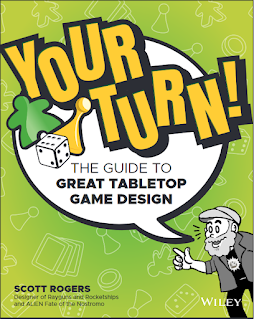
If you want more suggestions for great games, I recommend checking out my book "Your Turn! The Guide to Great Tabletop Game Design" - not only are there lists of "ten games of this genre you must play" in each chapter but also many ideas for mechanisms and examples of games that you can make yourself! Your tabletop game design journey starts here!

*Thanks to Chris Backe who inspired me to write my own list!


Sunday, January 3, 2021

The "Best" Board Games of All Time?


I recently read this listicle on the Better House and Garden Magazine website: a magazine that has a pretty big readership*.

I'll spare you the read:

The Game of Life, Clue, Candyland, Monopoly, Scrabble, Battleship, Risk, Stratego, Axis and Allies, Chess, Backgammon, Checkers, Chinese Checkers, Blokus, Agricola, Connect Four, Twister, Operation, Don't Break the Ice, Hungry Hungry Hippos, Boggle, Mouse Trap, Jenga, Mastermind, Qwirkle, Uno, Cranium, Dominos, Chutes and Ladders, Carcassonne, Traffic Jam, Trouble, Ticket to Ride, Sorry!, Yahtzee, Pictionary, Apples to Apples, Scattergories, Catchphrase, Taboo, Speak Out, Password, Mad Gab, Trivial Pursuit, Catan, Dominion, Cribbage, Cards against Humanity, and Azul

My first emotion when I finished reading this list was frustration.

Frustration that so many "hum-drum" games are still getting attention after all of this time. Traffic Jam, Mouse Trap and Hungry Hungry Hippos barely qualify as games - they're more like puzzles or toys. And does any one really need to be reminded about the existence of Chess, Checkers or Backgammon? This list read like the shelf at my local Goodwill.

To the list creator's credit, they did add some "newish" games like CAH, Qwirkle, Azul, and Dominion, but even most of those are over 12 years old! Hardly the new hotness.
It's not to say that (most) of these games don't deserve to be on the "best of all time" list (although I would hotly argue against CAH) but is this really the best games of all time? Surely there are games more interesting and exciting that deserve to bump a few of these off this list?

...OR is this list a challenge to us game designers who are trying to make a mark? I think we game designers can learn from this list because, like it our not, it shows us our competition.

Let's look at some common factors about all of these games:

1. Almost half of the games are over 50 years old.
Chess, Checkers, Backgammon, Chinese Checkers, Sorry!, Monopoly, Twister, Dominos, Risk, Stratego, Candyland, Clue, The Game of Life, Mastermind, Password, Battleship, Operation, Don't Break the Ice, Mouse Trap, Chutes and Ladders, Trouble, Yahtzee, And Cribbage - with several (Uno, Mad Gab, and Hungry Hungry Hippos) creeping up on 50.
The "problem" with these games is that they are institutions. Games that have become part of the social consciousness although the consciousness of this list is very Euro/Western-centric list - where is Mahjong, Go, or Parcheesi?

These are games whose imagery is burned in our collective brains. If you were to go outside right now (OK, use social media instead) and if you asked people to "name a board game" 75% (if not more) of the people asked would answer one of games on the above list**.

These are games that are considered "evergreen" games. Games that have sold for decades. I guarantee if you were to go to Hasbro and ask which would you rather publish, Clue or my new game? You know who is going to win out. In a way, those successful games keep our new games off the shelves.

This is a "problem" for us game designers. Unlike video games, board games never really age or go out of fashion. Their graphics don't look dated (mostly) and their hardware doesn't fail over time.

"Every game is our competition" someone once said***. This makes it really tough (and frankly, stupid) to say "I am going to design the next (fill-in-the-blank-game-from-the-above list)" because those games are so cemented in humanity's collective brains that they aren't going to get unseated any time soon. And we shouldn't even try.

At the 2019 Tabletop Network Conference, Martin Wallace advised game designers to "not grow your tree in the shadow of a bigger tree" - which I think is a great metaphor... but it also makes our job that much harder.

Being original is HARD. (and some would say, it's impossible to be original any more - you can only be "novel" or "unique".) 
 
Look at the "youngest" games on the list - Dominion, Qwirkle (both 2008), Cards Against Humanity (2009), and Azul (2017). It's not unfair to say these games are "just" revised or rethemed versions of Magic the Gathering, Dominoes, Apples to Apples and Majhong. Is this a strategy to success? Simplify an already simple game or even just "make it prettier"?
 
2. Most (98%) of these games are for "all-ages".
Which really means that they are relatively easy to learn how to play (Agricola and Dominion being the list's exceptions). 
 
The hobbyist board game community often looks down on "easy to learn" and "simple" as a negative - as a game that isn't extremely complicated isn't worth our time. There's even a derogatory name for these type of simple games - "filler games" - as in these games just "fill the time" between bigger, more worthwhile games. We, as game makers, need to get over ourselves if we want to make games that stand the test of time like those games above and embrace (if not celebrate) simplicity.
 
3. None of these games are "genre" games.
None of these games are about the following genres: Fantasy, Science-Fiction, Superheroes, Westerns, Dungeons, Dragons, Cthulhu or Zombies. 
 
Five of these games are about warfare (and that's because the list-maker had a category called "strategy games"), two are about farming, one is about murder, one is about finance, and one is about traffic***.
 
Most of these games are abstract - meaning there is no story, no characters, no setting for these games. They are "first person" games where the player is "just" the player.
 
This observation says to me: "if you want your game to be successful, it needs to be relatable." It either needs to be about something that happens in real-life (like farming or traffic or murder) or that it exist in that abstract place where games seem to live - the realm of mechanisms over theme. 
 
Now, this one is a bitter pill for me to swallow. Despite being the creator of Pantone the Game, I'm a "theme first" kind of guy. Does this mean if I want to compete with the "big-boys" I need to think more abstractly?
 
4. These games are tactile.
While tactility is an important part of game design, these games are "not just card" games. Life, Monopoly and Traffic Jam have little cars. Candyland has gingerbread pawns. Scrabble, Dominoes, Qwirkle and Azul use chunky tiles. Chinese Checkers use marbles. Sorry uses cones. Pegs and Pawns. Meeples and Tokens. Some of them use "unusual" interface tools such as tweezers, hammers, modelling clay and even your own body parts. In fact, only 12 of the games on the list use cards at all.
 
These games are also "toyetic" - or have a toy-like quality to them. Mouse Trap is not much of a game, but it is one heck of a toy. There are two types of game makers out there. The "inventors" who make games for the mass-market companies: Hasbro, Mattel, Griffen, Wonderforge and the "game designers" who make games for everyone else. Whose games do you see more of on the shelf at your local big-box store?
 
5. Most of these games are for many players.
I think it's fair to say that most of these games are considered "kids" games or "party" games, but they are also for 4 or more players. 
 
There are some exceptions (Chess, Backgammon, Connect Four, Mastermind, Stratego) but as all games are social, the games on this list exploit the social aspect that board gaming caters to so well. 
 
See how many players it takes before your game "breaks" - either takes too long for players between turns or there isn't enough physical space around the board or enough cards to go around. The more players the better! (Pro-tip, you can break players into teams to maximize player count - that's how Pantone the Game plays 2-20 players!)
 
These games also encourage interaction amongst players, there no "multiplayer solitaire" or "parallel play" happening in these games. Keeping a player engaged in the game at all times should be a standard goal for any game designer... but I admit, sometimes I forget to think about it. (This is why I write this stuff down, dear reader)
 
So what is a game designer to do?
If we want to be competitive, take a long look at the competition... and then try to find your own spot to "plant your tree" - away from the air and water-sucking games on this list.
Design a game about a relatable activity for a group of people, that has a tactile element and is easy to learn. Then maybe next year we'll see your game***** on this list!
 
Footnotes:
* According to the interwebs, Better Homes and Gardens has a readership of somewhere between 7.6 and 30 million readers (!!!) - It's the third largest paid magazine circulation in the United States. That's a list worth getting on!
 
** As I was writing this blog post, I ran my own poll on social media. Granted, many of my friends are "gamers" who play and know about all types of board games, but even still, 75% of them listed a game from that list above as the game they think of when I say "Name a board game". Booyah! Right on the nose with my original estimation!
 
*** It might have been Rob Daviau who said this. I forget.
 
**** A game about traffic? Does this finally mean vindication for Randall Hoyt?
 
***** For the record, I would have replaced a few of the games on that list with Quiddler, Pandemic and Codenames.

Thursday, December 28, 2017

The Best Board Games of 2017

2017, what a year, huh?

Well, despite everything else that happened, 2017 was an amazing year for board gaming. There were so many great games that debuted this year. I haven't gotten around to playing all of them but here are the top ten board game new games from 2017 that I played in 2017. (Click on the title of the game for their link to their listing on BoardGameGeek.com)

Meeple Circus
What do you think of when you read the name "Meeple Circus"? This game lives up to that expectation and more. This meeple stacking game is easily the most charming board game I've played in a long time and every game will have you simultaneously thrilled and laughing out loud.

Sagrada
Dice games are very popular in my household and Sagrada manages to turn a dice builder into a challenging Sudoku-style game. Sagrada is quick playing, easy to learn and beautiful on the table.

Unearth
I used to call "Formula D" the best use of polyhedral dice, but Unearth is challenging that title. The clever dice system matched with some lovely graphics makes for an engaging game.

Charterstone
2017 was a great year for worker placement games and Legacy-style games but Charterstone gives players the best of both worlds. It starts a little slow, but after a game or two, you be looking forward to leveling up your guild and find yourself hungry for more. 

Massive Darkness
IMHO, Massive Darkness is the spiritual successor to HeroQuest we've all been waiting for. Simple to learn, but it's campaign system will give you hours of play. It sports a clever leveling system, wildly flexible character creation and some of the coolest miniatures around. And what's a good dungeon crawler without lots of combat!?

Heaven and Ale
Do you like your strategy games heavy? In this game about beer-brewing monks, Heaven and Ale's unique combination of "do I go fast or slow" choice-making paired with "where do I put it" game play makes for a heady (pun intended) combination.

NMBR 9
Mesmerizingly beautiful and mind-bendingly challenging, this shape-stacking game is easy to play and tricky to master. 

Dark is the Night
 An intriguing two-player game of cat-and-mouse where one player is the hunter and the other is the monster in the dark. For such a small and simple game, it packs a pretty big punch!

Sparkle*Kitty
A social game that doesn't rely on profanity to be fun! The evil Sparkle Kitty has imprisoned Princesses in their towers but these Princesses aren't going to wait for anyone to rescue them! By saying magic phrases, the players can rescue themselves! Sparkle*Kitty is fast, fun and friendly for the entire family.

Einstein: His Amazing Life and Incomparable Science
This charming pattern building game is the first in an intriguing new concept: the biography-based board game. It's a great way to learn more about the man who we have all heard of, but could always learn more about. The possibilities of games based on the famous figures of history is mind-boggling...

Rayguns and Rocketships 
Special mention: 2017 is especially important to me because it is the year my own board game Rayguns and Rocketships was successfully Kickstarted and released! If you love the golden-age of science fiction, skirmish action and lots of great miniatures in your board games, then please check it out!


 Have your own recommendations for the best game of 2017? Add them to the comments below!

Wednesday, December 28, 2016

The best games I wished I had played in 2016

Happy (almost) New Year!

While I own several board games, I don't often get many chances to play them. Rather than post yet another "best of the year" list, here are the 10 games I wished I had gotten a chance to play in 2016.

NOTE: Most of these games on this list are still sitting on my shelf in shrink wrap.  So, these are my ill-informed impressions of what may or may not be the best games of 2016.

10. Star Wars Clue


I don't care how hokey the original game is, I still really like Clue. I have a few versions of it (still need to get the Dungeons and Dragons version) and when I took one look at that 3D model of the Death Star I had to have it! I mean, look at this thing!


I already have some cool Star Wars Command figures and that Death Star is going to double as a rad playset for them! My lovely wife got this for me for Christmas but when I asked my family if they wanted to play, they all watched "It's a Wonderful Life" instead. Maybe I'll get it out of shrink-wrap before 2017 is over.

9. Star Trek Panic

Let's get this straight. I am a Star Wars fan. Star Trek was always 2nd (actually 4th or 5th) down the line in my favorite space-centric franchises, but there is something about that cardboard Enterprise that you can attach explosions to that is just so cool!

2016 is going to go down in my book as the "year of the rad cardboard 3D models in board games" (see other entries below). I have always loved the "toyetic" nature of games and that is what drew me to Star Trek Panic. I had played the original Castle Panic (meh but my son likes it) I resisted buying this at Gen-Con because I was already lugging enough games back to California as it was. So I waited until to buy it when came out in stores. Now I am waiting to actually play this game with someone.

8. Raptor

First of all, Raptor is designed by two guys named Bruno. And they're really good game designers too. Secondly, I was working on my own "dinosaur island" themed board game (It's called "Diamonds and Dinosaurs" - I'd keep the name but the D&D acronym is already taken. Who knew?) and wanted to see how this one played. Thirdly, take a look at this game! Miniature Dinosaurs and 3D mountains!? It's like Jurassic Park in a box!


In Raptor (according to the back of the box) you are a pissed-off Mamma Raptor defending her adorable little babies from tranquilizer dart gun wielding scientists! It's actually an asymmetrical game that looks like it could be really viscous and a lot of fun, but I wouldn't know because I haven't played it yet.

7. Above and Below

I had the pleasure meeting Ryan Laukat at Gen-Con this year and he was a very nice guy. That's why I bought "Above and Below." In addition to being a nice guy, his games are beautiful (he does all of the art himself) and I hear they are fun to play. They look nice in the pictures.


I wanted to check this one out because I had been working on a design about a village that lived above a dungeon and heard "Above and Below" was essentially the same idea.I wouldn't know if it is any good however, because I haven't played it yet. One day. One day...

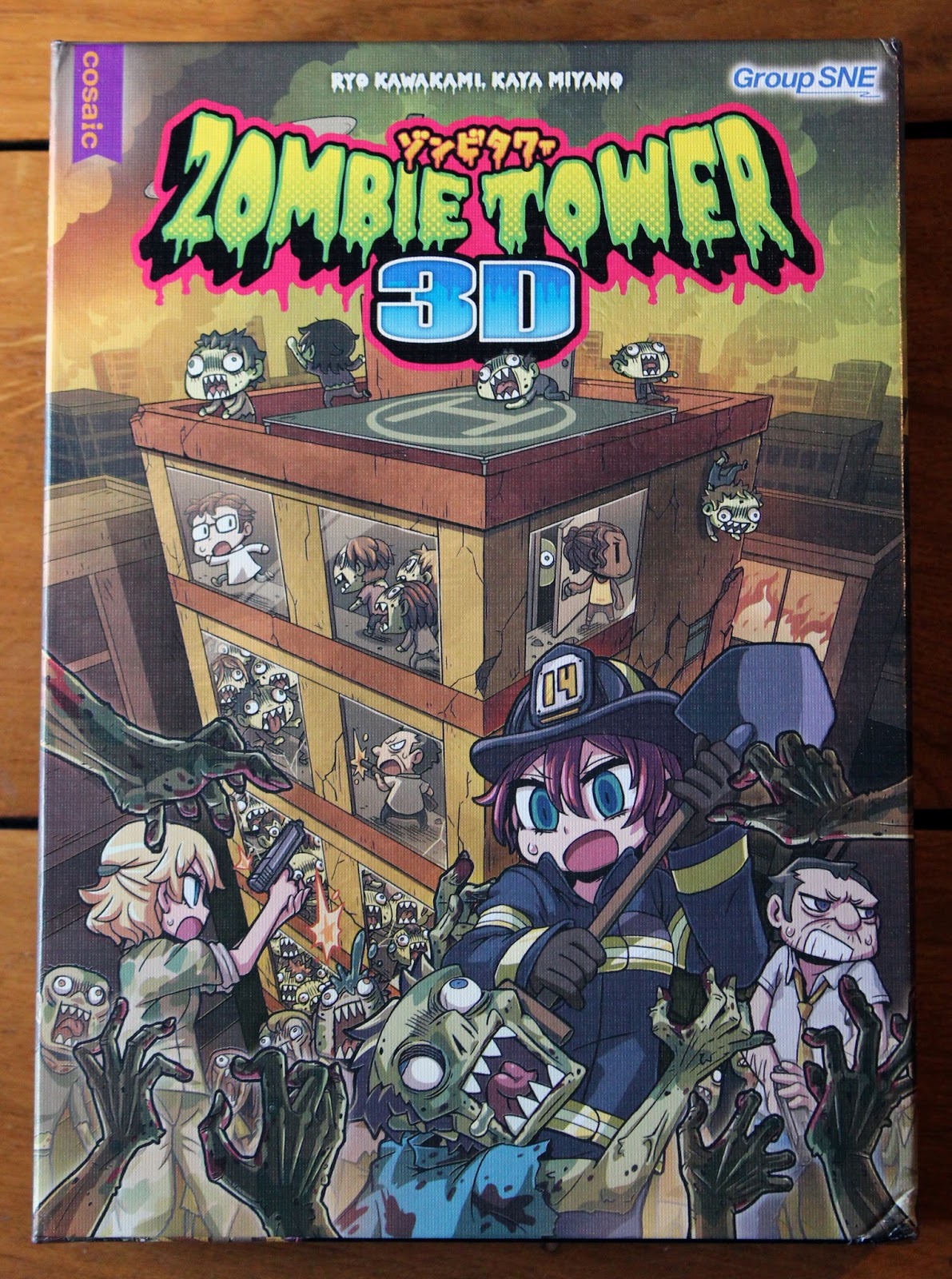
6. Zombie Tower 3D
 

Look at this thing! It is a thing of beauty! Who cares if it is yet another Zombie game? It has a 3D building!! And this is what I was thinking when I backed Zombie Tower 3D when it was on Kickstarter  Right after I backed it, I just missed demoing the game at Strategicon (they were packing it up as I got there) but once again, I am a sucker for a 3D board. It might have something to do with playing Voice of the Mummy as a kid.


 Zombie Tower 3D is a cooperative game where you avoid getting eaten by Zombies as you pass items through cracks in the building. The only thing that would make it better, would be miniatures. Maybe in an expansion. I can't wait to try it out. Maybe in 2017?

5. Orcs Must Die the board game

I've called the video game of Orcs Must Die the game that "I wish I made." The video game plays like "Tecmo's Deception" and the main character even looks a bit like Maximo. This is another game I backed on Kickstarter and it took FOREVER to arrive. I had actually forgotten that I had backed it when it showed up at my door late this year.


As far as I can tell, it's a tower-defense style game (like the video game) but in board game form. You set up traps and fight against waves of orcs with your heroes. All I know is it has a modular board and lots of miniatures - two other things I am a sucker for. But will it be any fun to play? I'll let you know when I actually play it!

4. Vast - the Crystal Caverns


This was another game I backed on Kickstarter - twice. Once for the game and a second time for really cool miniatures that the game didn't intially come with. The art on this game is stellar and the concept - a dungeon crawl (again love) where you can either play the knight, the goblin horde, the thief, a dragon or... the cave itself!! So great.


Now I've heard the game itself is a little arcane. I tried to figure out the rules to no avail - but that might have been because I was trying to read them at 2 am after a full day of attending Gen-Con. Maybe I'll get a chance to play the game before Gen-Con 2017.

3. Escape from the Aliens in Outer Space


I have heard that Escape from the Aliens in Outer Space is the "scariest board game ever" and the concept sounds like something straight out of the original Alien film. In it, players attempt to reach the airlock of a space ship (or space station) while being stalked by a horrible alien which will take over take them and turn them into aliens as well.


The challenge is that the player can't see where they are going. There is no shared board - only a battleship style map that each player use to plot the last known locations of their fellow players. Everyone is stumbling around blind until they escape or run into an alien. It sounds amazing. I hope to play it soon.

2. Pandemic Legacy Season 1

Guess who has two thumbs and still hasn't played the "best game of 2015"? I don't know much about Pandemic Legacy since I didn't want to spoil the game for myself. All I know about it that it plays like Pandemic, it is really good, it finally bumped Twilight Struggle out of the #1 spot on BGG and has some huge plot twists in it. Oh, and that there is no difference between the red box and the blue box. I heard that one straight from the designers themselves.

But if getting people to play Pandemic Legacy is as hard as it was to get people to commit to playing the also-awesome Risk Legacy, then I probably won't be playing Pandemic Legacy until 2018.

1. Star Wars Rebellion - Fantasy Flight Games

Dice Tower reviewer Tom Vasel calls this game "Star Wars in a box" Considering that we have already gotten Star Wars in a box several times over, this seems like a pretty bold claim. What Rebellion appears to be is a galaxy-spanning strategy game that features all of the heroes and villains of the original trilogy (sans Rogue One - perhaps in an update?) and lots of gorgeous and tiny miniatures of stormtroopers and rebel troopers and x-wings and TIE fighters.


The game even comes with three models of the Death Star - two built and one under-construction! This game has been topping many list of "the best of 2016" and I guess my list is no different. I look forward to spending a little time in a galaxy far, far away very soon.

UPDATE: Just as I wrote this entry, I was invited over to a friend's to play Rebellion. However, I had other obligations and had to decline. I can't wait for this year to be over.

Sunday, December 4, 2016

2016 Board Game Gift Guide


I was putting together a holiday tabletop gaming gift guide, but it was starting to feel like every other list on the internet: Ticket to Ride, Betrayal at the House on the Hill, Qwixx, Pandemic Legacy Season 1. All great games you should play. You probably already own them all. I do.


So then I thought about making a gift guide based on some of the great new games that came out in 2016: Scythe, Vast, Secret Hitler, World of Yo-Ho, The Last Friday. But I realized I haven't played too many games that came out in 2016. And many of these are still hard to find or not available to the average consumer.


So I decided I would highlight games that were made by board game designer friends of mine. These are all great games but more importantly, great games made by great people. If you want them to keep making games, please buy a copy or two.

SEAFALL
Designer: Rob Davieau
Publisher: Plaid Hat Games

Rob Daviaeu is best known for designing the game-changing Risk Legacy. If you don't know what a Legacy game is, it's where the game reflects the evolving state of the ongoing game each time you play. Rob describes this game as "Indiana Jones on the high seas" which sounds pretty cool to me.

Buy Seafall at Amazon.com

JUNK ART
Designers: Sen-Foong Lim and Jay Cormier
Publisher: Pretzel Games

Sen-Foong and Jay are the dynamic duo of board game design. They've released several games this year, but Junk Art is their most intriguing. Don't be fooled by how simple it looks. It may resemble Jenga, but it has 50 different game variants.

Buy Junk Art at Amazon.com


THE NETWORKS
Designer: Gil Hova
Publisher: Formal Ferret Games

Gil's The Networks was the surprise hit of this year. I'm not surprised as it is a clever idea that lends itself naturally to a board game. In the Networks, you run your own TV station. You start with three awful public access programs and snatch up new shows, stars and advertisements. You start to assemble blocks of programming and  determine how long the shows run for as they gain viewers. The game is filled with lots of fun parodies of TV shows.

You can get a print and play version at Formal Ferret's website
Get the expansion at Amazon.com


THE DRAGON AND FLAGON
Designer: Geoff, Sydney and Brian Engelstein
Publisher: Stronghold Games

The Engelsteins are some of my favorite people in board gaming and their Dragon and Flagon is a great family game about a bar fight. D&F is boisterous pre-programmed bar brawling game has fantasy archetypes (wizards, fighters, monks, pirates, etc.) battling it out for a magical brew that bestows super-powers. Chairs are thrown, chandeliers are swung from and there's lots of chaotic silliness. Plus if you are a fan of HeroQuest's tiny furniture, then this game is for you.


Buy the Dragon and Flagon on Amazon.com
TEENAGE MUTANT NINJA TURTLES: SHADOWS OF THE PAST
Designer: Kevin Wilson
Publisher: IDW Games

This game kills two birds with one stone for me. The publisher, IDW Games, has picked up my own game Rayguns and Rocketships (coming soon!), and Erik Burnham, my old Shooting Star Comics buddy who sometimes writes the current TMNT comic book. The minis are gorgeous in this campaign-style skirmish game and if you like games like Descent or Star Wars Imperial Assault, then you will like TMNT:SOTP

Buy TMNT: SOTP at the IDW Store


MUNCHKIN MARVEL
Designer: NA
Publisher: Steve Jackson Games

My pals over at Steve Jackson Games have been making great games for a long time. Even if you don't like Munchkin, I suggest giving their new Marvel version a try. It uses some great Marvel art and it somehow feels a more appropriate use of the Munchkin play system than even the original game. Plus there is already one expansion out featuring Marvel Knights heroes Luke Cage and Dr. Strange.

Buy Marvel Munchkin at Amazon.com
BETRAYAL AT HOUSE ON THE HILL: WIDOW'S WALK
Designer: Mike Selinker and friends
Publisher: Wizards of the Coast

Mike was the lead developer of BAHOTH - which happens to be one of my all-time favorite games. When he announced that an expansion was coming out, us fans of the original were justifiably excited. The new set features a few new room, omens, items and 50 new haunts written by a who's who of game designers and a few creatives from other mediums. Keep in mind that you need the base game to play it.

Buy BAHOTH at Amazon.com
Buy Widow's Walk Expansion on Amazon.com


KINGDOM DEATH: MONSTER
Designer: Adam Poots
Publisher: Kingdom Death

I don't know Adam Poots personally, but I could not leave this game off this list. His Kingdom Death: Monster is called a "boutique cooperative nightmare horror game" and everything about it definitely fits that description. The miniatures are of amazing detail and the game play is strong (I played a demo at Gen-Con this year) Everything I've heard and read and seen about this game is the highest quality. Beware, this game is not for everyone - the subject matter is extremely dark, mature and even sexual - but you cannot deny it is extremely captivating.

I missed the original Kickstarter in 2013 (pesky cancer) but followed it's rise ever since it raised over 2 million dollars. It has some of the highest ratings of any game on Boardgamegeek. The only way to buy the base game was through the gray market (where it was selling for over $1000 on ebay) but Poots has created a second chance Kickstarter campaign - a 1.5 version with some new rules updates but essentially a second edition - which as of his writing has 33 days to go and has raised over $7 Million dollars. It will probably end up being the highest grossing Kickstarter in history. The game itself is very expensive ($350 for the Gold Lantern Level which includes the base game and the "Gambler's box" add-on) but it is, as some have called it, the "Ferrari of board games." If you have the means, I highly recommend it.

Kingdom Death: Monster 1.5 Kickstarter (live now!)
Kingdom Death website (which sell some minis and expansions)